


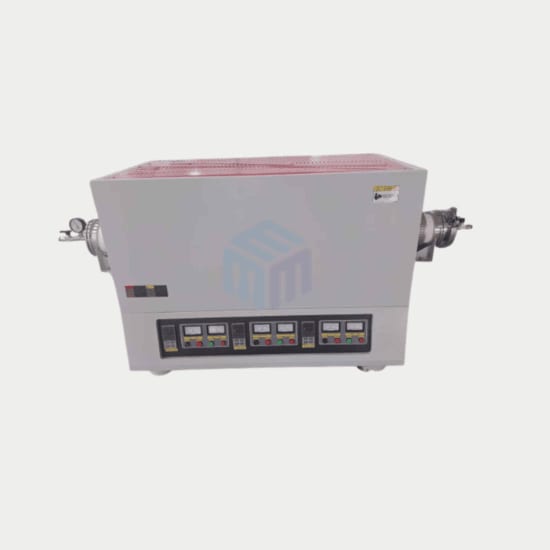
The development of lithium-ion batteries, sodium-ion batteries, solid-state batteries, and other advanced energy-storage technologies requires precise control over material synthesis and heat treatment. Battery materials often undergo processes such as calcination, annealing, sintering, reduction, oxidation, and thermal decomposition, where even small changes in temperature or atmosphere can influence the final material properties.
A tube furnace provides a controlled environment for these high-temperature processes. Unlike a conventional furnace, a tube furnace allows researchers to place materials inside a process tube and control the surrounding atmosphere. This makes it particularly valuable for battery-material research, where temperature uniformity and atmospheric conditions can directly affect phase formation, particle morphology, composition, and electrochemical performance.
For Indian universities, battery research centres, R&D laboratories, and manufacturers developing next-generation energy-storage materials, selecting the right laboratory tube furnace is an important part of establishing a reliable experimental process.
Why Are Tube Furnaces Important for Battery Materials?
Battery materials are highly sensitive to processing conditions.
During material synthesis, researchers may need to carefully control:
- Heating temperature
- Heating rate
- Holding time
- Cooling rate
- Gas composition
- Gas flow rate
- Oxygen availability
For example, cathode materials may require controlled calcination to obtain the desired crystal structure, while other battery materials may require an inert or reducing environment to prevent unwanted reactions.
A high temperature tube furnace allows these parameters to be controlled more precisely.
Temperature Control in Battery Material Processing
Temperature is one of the most important variables in battery-material synthesis.
Different materials require different thermal treatment temperatures depending on their chemistry and intended structure.
A controlled temperature profile can help researchers achieve:
- Desired phase formation
- Controlled crystallinity
- Consistent particle characteristics
- Removal of volatile components
- Improved material uniformity
Simply reaching the required maximum temperature is not enough. The furnace should also provide stable temperature control throughout the process.
Importance of Temperature Uniformity
Temperature uniformity is particularly important when processing battery powders or precursor materials.
If different parts of the sample experience significantly different temperatures, the resulting material may have variations in:
- Crystal structure
- Particle morphology
- Composition
- Degree of reaction
A quality laboratory tube furnace is therefore designed to provide a controlled heating zone where the sample can be processed consistently.
For research laboratories, this can improve repeatability between experiments.
Controlling the Atmosphere
Temperature is only one part of the equation.
Many battery-material processes also require a specific atmosphere.
Depending on the material, researchers may use gases such as:
- Nitrogen
- Argon
- Oxygen
- Hydrogen-containing mixtures
- Other controlled process gases
The selected atmosphere can influence oxidation state, phase formation, surface chemistry, and other material characteristics.
Inert Atmosphere Processing
Inert gases such as nitrogen or argon are commonly used when researchers need to reduce exposure to atmospheric oxygen.
An inert atmosphere can be useful for materials that may:
- Oxidize
- React with moisture
- Decompose in air
- Undergo unwanted surface reactions
A tube furnace equipped with suitable gas inlet and outlet arrangements can create a controlled processing environment around the sample.
Oxygen-Controlled Processing
Some battery materials require oxygen-containing atmospheres during thermal treatment.
In such cases, the furnace must be capable of maintaining the required gas conditions throughout the heating cycle.
Controlled oxygen processing can be important for producing the desired phase and chemical composition of certain electrode materials.
Reducing Atmospheres
Certain research processes may require reducing conditions.
Hydrogen-containing atmospheres, for example, may be used in specialized material-processing applications.
However, combustible and reactive gases require appropriately designed equipment, gas handling systems, ventilation, and safety controls. The furnace and gas system must be selected specifically for the intended atmosphere.
Applications of Tube Furnaces in Battery Research
1. Cathode Material Synthesis
Tube furnaces can be used for thermal processing of cathode precursor materials.
Researchers may use controlled heating to develop the required crystal structure and composition.
Applications can include research on:
- Lithium transition-metal oxides
- Phosphate-based materials
- Manganese-based materials
- Nickel-containing cathode materials
The exact temperature and atmosphere depend on the material chemistry and synthesis route.
2. Anode Material Development
Tube furnaces are also useful for developing and modifying anode materials.
Thermal treatment can be used for:
- Carbonization
- Graphitization
- Material modification
- Composite formation
- Surface treatment
Controlled atmospheres are particularly useful when oxygen exposure must be minimized.
3. Solid-State Battery Materials
The development of solid-state batteries has increased interest in controlled thermal processing.
Researchers may use tube furnaces for:
- Solid electrolyte synthesis
- Ceramic processing
- Sintering
- Annealing
- Interface studies
Precise temperature control is essential because excessive heating can affect material composition or cause undesirable reactions between different components.
4. Battery Recycling Research
Tube furnaces can also support research into battery recycling and material recovery.
Thermal treatment may be investigated for:
- Decomposition
- Recovery of valuable materials
- Removal of binders
- Thermal separation
- Material regeneration
Controlled atmospheres can help researchers study how different thermal conditions influence material recovery.
What Affects Tube Furnace Price?
The tube furnace price depends on several factors.
These can include:
- Maximum operating temperature
- Furnace size
- Number of heating zones
- Tube material
- Tube dimensions
- Temperature controller
- Gas-control system
- Vacuum capability
- Programmability
- Heating-element type
- Insulation
- Customization requirements
A basic lab tube furnace designed for straightforward heating applications will generally have different specifications and pricing from a multi-zone system designed for controlled-atmosphere battery research.
Therefore, laboratories should compare complete specifications rather than selecting a furnace based only on initial purchase price.
How Tube Furnaces Support Repeatable Battery Research
Repeatability is essential in battery-material development.
Researchers often need to reproduce the same synthesis conditions across multiple batches.
A properly configured tube furnace India solution can help establish repeatable:
- Temperature profiles
- Heating rates
- Holding times
- Atmosphere conditions
- Cooling procedures
This allows researchers to compare material properties more reliably between experiments.
Conclusion
Battery-material development requires precise control over both temperature and atmosphere. A tube furnace provides researchers with a controlled environment for thermal processes such as calcination, annealing, sintering, carbonization, and material synthesis.
For battery research, selecting the right laboratory tube furnace or lab tube furnace involves evaluating temperature uniformity, operating temperature, tube material, atmosphere-control capabilities, heating zones, and programmable controls.
As India’s battery and energy-storage research sector continues to develop, reliable high temperature tube furnace systems can play an important role in producing consistent materials and improving the repeatability of research experiments.
When selecting a tube furnace India solution, laboratories should focus on the complete application requirements rather than simply comparing the tube furnace price. The right combination of temperature control, atmosphere management, and furnace configuration can provide a dependable platform for advanced battery-material research.
Looking for a reliable tube furnace, high temperature tube furnace, or laboratory tube furnace for battery-material research and advanced material processing?
We supply laboratory and industrial furnace solutions suitable for controlled thermal processing, research, material synthesis, and heat treatment applications across India.
📞 Call: +91-9898892994 OR 📧 Email: marketing@mkubeenterprise.co.in
Contact us today for expert guidance, competitive tube furnace price, and the right lab tube furnace configuration for your application.