



Coin Cell Preparation
Inquiry NowProduct Description
Coin Cell Preparation Equipment for Lithium Battery R&D
Looking for reliable coin cell preparation solutions for your lab or battery research facility? M-Kube offers a complete range of button cell assembly tools and coin cell components to simplify your battery development workflow. Whether you’re working on lithium-ion, solid-state, or custom chemistries, our equipment ensures repeatable, precise results every time.
From electrode punching and crimping to sealing and testing, our tools are designed to meet the stringent demands of battery R&D. Ideal for universities, research labs, and pilot production lines, our solutions support all major coin cell formats, including CR2016, CR2025, and CR2032.
Key Equipment for Coin Cell Assembly
We supply complete tools and modules for:
- Coin Cell Die Sets – Compatible with CR2016, CR2025, CR2032 formats
- Electrode Cutting Tools – Manual and semi-auto punchers for precise shapes
- Coin Cell Crimping Machines – Consistent sealing of anode/cathode
- Glove Boxes & Inert Atmosphere Systems – For moisture-sensitive assembly
- Drying Ovens & Vacuum Chambers – Ensure contaminant-free results
- Coin Cell Disassemblers & Testers – Ideal for post-cycle analysis
Core Coin Cell Components
M-Kube offers one of the finest quality and precision coin or battery cell components for battery research.
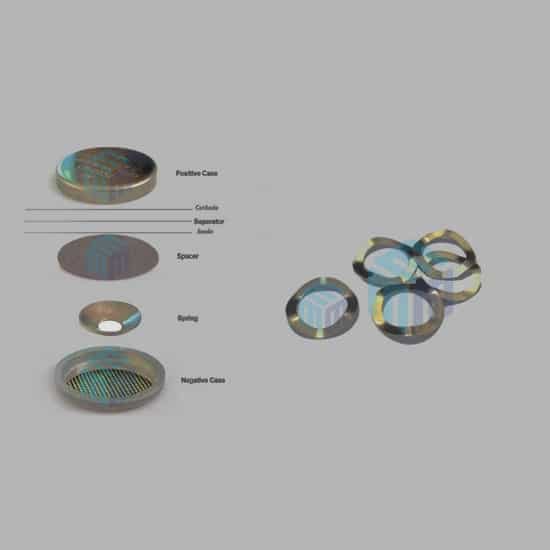
a. Coin Cell Case
- Available in coatings such as Aluminium, Stainless Steel 304 (SS 304), Stainless Steel 316 (SS 316), Platinum, Gold, Tin, etc.
- Supplied in 100 pcs/bag
- Can be supplied with gaskets/O-rings
- Options for One Side/Two Side Kapton Window
- Meshed Coin Cells also available
b. Coin Cell Spacer
- Manufactured with Pure Aluminium, Stainless Steel 304 (SS 304), Gold-coated Stainless Steel 304 (SS 304)
- Supplied in 100 pcs/bag
c. Spring
- Options include:
- Stainless Steel 316 (SS 316) Conical Spring
- Stainless Steel Wave Spring (Belleville Washer)
- Aluminium Clad Stainless Steel Wave Spring
- Gold-plated Stainless Steel Spring
- Gold-coated Stainless Steel Wave Spring
Applications
- Coin cell preparation for lithium-ion R&D
- Academic research & university projects
- Material testing for cathode, anode & electrolyte development
- Small-scale prototyping of button cells
Why Choose M-Kube?
- High-purity coin cell components with precision manufacturing
- Multiple material coating options to meet diverse research needs
- Compatible with standard coin cell preparation equipment
- Trusted supplier for Indian R&D and battery innovation labs
📞 Get in Touch for Expert Support
Looking to build or upgrade your coin cell preparation lab?
📞 Call us at +91-9898892994
📧 Email us at marketing@mkubeenterprise.co.in
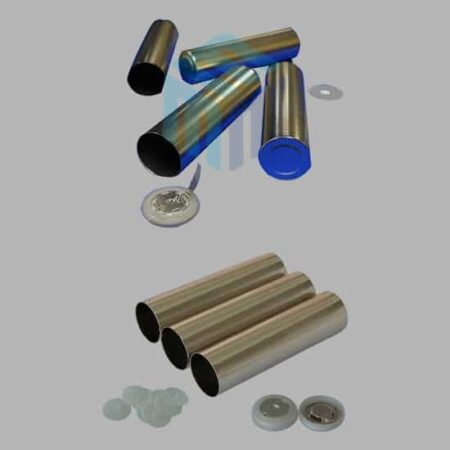
Let our experts recommend the right solution tailored to your battery research needs. We also offer cylindrical battery cell components designed for reliable performance in battery research and development.
Product FAQ's
What is the composition of a coin cell?
A coin cell is typically composed of the following key components:
- Positive cap (cathode case)
- Cathode material (e.g., lithium cobalt oxide)
- Separator (microporous film)
- Anode material (e.g., lithium metal or graphite)
- Electrolyte
- Spacer and spring
- Negative cap (anode case)
These coin cell components are sealed together using a crimping process during coin cell preparation or button cell assembly.
What are the main coin cell components?
A standard coin cell consists of a positive case, negative case, electrode sheets, separator, spacer, spring, and electrolyte.
What are the essential coin cell parts used in button cell assembly?
Core parts include the stainless steel case (caps), spacer, spring (e.g., wave or Belleville), gasket or spacer seals, and the separator.
What’s involved in coin cell preparation?
The process involves cleaning components, handling them in a dry environment (e.g., glovebox), layering electrodes, adding electrolyte, and crimping the case, followed by inspection.
How is button cell assembly performed?
Begin with the negative case, then add the lithium or electrode material, separator, electrolyte, spacer, spring, and positive cap, and finally crimp tightly to seal
Why is timing and amount of electrolyte important in coin cell assembly?
Precise electrolyte injection timing and volume ensure proper wetting and solid-electrolyte interface (SEI) formation, vital for consistent cell performance
What are good practices for reproducible coin cell preparation in research labs?
Use standardized assembly methods, repeat batches (e.g., at least five cells per setup), clean components thoroughly, and control environmental conditions to improve reproducibility.
Related products

- Phone: +91 9898892994
- Address:
2, Shital Kunj Society,
Navrangpura, Ahmedabad 380009,
Gujarat, India. - Email: marketing@mkubeenterprise.co.in