

When it comes to high-temperature heating, industrial furnaces are built for large-scale, continuous operations in manufacturing, offering durability and high output. In contrast, lab furnaces like a lab tube furnace focus on precision, control, and small-batch testing—ideal for research, material development, and experiments in controlled environments. Understanding these differences ensures the right furnace choice.
Industrial Furnaces
Industrial furnaces are designed for large-scale applications and typically operate at higher temperatures to process metals, glass, ceramics, and other materials. They are robust, high-capacity, and optimized for continuous, high-demand production environments.
Types of Industrial Furnaces
Industrial furnaces come in many forms—such as reheating, annealing, tempering, induction, electric arc, rotary, crucible, vacuum, conveyor, and blast furnaces—each tailored to specific materials and process needs.
They vary by heating method, capacity, and application—with combustion, electric, or hybrid heating used for tasks ranging from metal melting and heat treatment to sintering and continuous thermal processing
Blast Furnace
- Application: Primarily used in the steel industry for smelting iron ore into molten iron.
- Size and Capacity: Capacities can exceed 1,000 tons of molten iron per day.
- Temperature Range: Up to 2,200°C (3,992°F).
- Benefits: Efficient for large-scale metal production.
- Limitations: High energy consumption, environmental impact due to carbon emissions.
Induction Furnace
- Application: Melting and refining metals like steel, copper, and aluminum.
- Temperature Range: 1,200°C to 1,600°C (2,192°F to 2,912°F).
- Size and Capacity: Typically ranges from 1 to 100 tons per batch, with larger systems for high-volume operations.
- Benefits: Precise temperature control, high efficiency, minimal emissions.
- Limitations: Requires specialized setup and significant electrical power.
Rotary Kiln Furnace
- Application: Used in cement, lime, and refractory manufacturing industries.
- Temperature Range: 1,000°C to 1,450°C (1,832°F to 2,642°F).
- Size and Capacity: Lengths can exceed 100 meters with capacities ranging from 50 to 1,000 tons per day.
- Benefits: Continuous processing, large capacity.
- Limitations: High fuel consumption, requires extensive maintenance.
Electric Arc Furnace
- Application: Melting scrap metal, primarily in the steel recycling industry.
- Temperature Range: 1,300°C to 1,800°C (2,372°F to 3,272°F).
- Size and Capacity: Can range from 5 to 400 tons per charge, depending on the size of the furnace.
- Benefits: Efficient for recycling, can reach high temperatures quickly.
- Limitations: High electricity consumption, potential for noise and dust pollution.
Annealing Furnace
- Application: Softening metals or glass through heat treatment to improve workability.
- Temperature Range: 200°C to 1,100°C (392°F to 2,012°F).
- Size and Capacity: Often ranges from a few hundred to several tons, depending on the design.
- Benefits: Enhances material properties, prevents metal cracking.
- Limitations: Requires precise temperature control; often a slow process.
Laboratory Furnaces
Laboratory furnaces are designed for small-scale testing, research, and material development in labs. They offer precise temperature control, safety features, and are compact for benchtop or small-space applications.
Types of Laboratory Furnaces
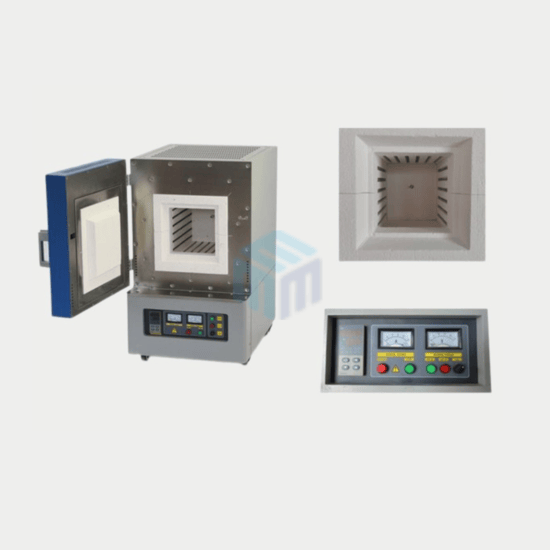
Laboratory muffle furnaces—such as box-type, tube-type, and vacuum muffle designs—offer precise, contamination‑free heating for tasks like ashing, sintering, and thermal analysis, with temperatures reaching up to ~1,800 °C. These furnaces are essential in labs for controlled atmosphere and sample integrity, featuring digital temperature control, safety interlocks, and efficient insulation for reliable, repeatable results
Muffle Furnace
- Application: Heating samples in ceramics, chemical, and metallurgical research.
- Size and Capacity: Typically has a volume of 1 to 5 liters, suitable for small sample sizes.
- Temperature Range: Up to 1,200°C (2,192°F).
- Benefits: Clean heat source, ideal for ashing and incineration.
- Limitations: Limited sample size, cannot be used for large-scale production.
Tube Furnace
- Application: Conducting thermal processing in a controlled atmosphere, often for material synthesis and oxidation.
- Temperature Range: 1,100°C to 1,800°C (2,012°F to 3,272°F).
- Size and Capacity: Usually has a tube length of 60 to 150 cm, with diameters ranging from 2 to 10 cm.
- Benefits: Excellent for creating precise, controlled environments.
- Limitations: Small capacity; requires careful handling of gases.
Ashing Furnace
- Application: Determining the mineral content in food, fuel, and other organic materials by combusting the organic matter.
- Temperature Range: 600°C to 1,100°C (1,112°F to 2,012°F).
- Size and Capacity: Generally ranges from 1 to 3 liters, suitable for small sample analysis.
- Benefits: Accurately measures ash content, compact design for lab work.
- Limitations: Limited to small samples; only suitable for specific applications.
Vacuum Furnace
- Application: Heat treatment in a vacuum environment, commonly used in metallurgy and material science research.
- Temperature Range: Up to 1,600°C (2,912°F).
- Size and Capacity: Typically designed for small batches, with chamber sizes from 10 to 100 liters.
- Benefits: Eliminates oxidation, ideal for sensitive materials.
- Limitations: Expensive, requires maintenance and special equipment to handle the vacuum.
Chamber Furnace
- Application: General-purpose lab furnace for heating, aging, or sterilizing samples.
- Temperature Range: 100°C to 1,200°C (212°F to 2,192°F).
- Size and Capacity: Usually has a capacity of 20 to 100 liters, allowing multiple samples.
- Benefits: Versatile; can handle multiple samples at once.
- Limitations: Limited to lower temperature ranges compared to other lab furnaces.
Also Read: Choosing the Right Laboratory Furnace for Your Research
In summary:
-
Lab furnaces offer tight temperature control, compact footprints, and precise environments—ideal for R&D and analytical labs.
-
Industrial furnaces deliver high capacity, durability, and process efficiency for large-scale production and manufacturing.
Choose based on your requirements for scale, precision, and environment: whether you’re supporting cutting-edge research or powering mass industrial operations. Let me know if you’d like a detailed infographic or a slide deck version of this comparison!
Ready to find the right furnace for your project? Get in touch with M-Kube at marketing@mkubeenterprise.co.in for expert recommendations and competitive pricing.
M-Kube Enterprise is an Indian company catering customized laboratory products, laboratory consumables, and laboratory solutions in India, Australia, New Zealand, Singapore, Malaysia, South Korea, Dubai, the Philippines, Indonesia, the USA, and Vietnam.