

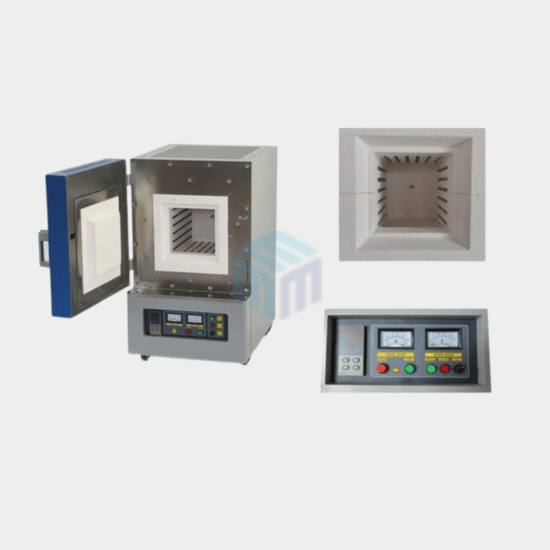
A muffle furnace is one of the most widely used laboratory and industrial heating devices for controlled high-temperature applications. Designed to isolate the material from combustion gases, these furnaces provide a clean and stable environment for precise heat processing.
From 1200 °C muffle furnace models used in basic lab work to 1800 °C high temperature muffle furnaces used in advanced materials research, their applications span multiple industries. Understanding how different sectors use these furnaces helps in selecting the right equipment based on muffle furnace temperature, performance, and budget considerations such as muffle furnace price.
Applications Across Different Industries
-
Metallurgical and Materials Industry
In metallurgy, muffle furnaces are essential for heat treatment and material analysis.
Common Uses:
- Annealing and sintering
- Hardening and tempering
- Ash content analysis
- Metal purification
Higher-end models such as 1400 °C muffle furnace, 1600 °C muffle furnace, and 1800 °C muffle furnace are used for advanced metallurgical applications where precise thermal control is required.
-
Pharmaceutical Industry
Pharmaceutical laboratories rely on muffle furnaces for quality control and formulation testing.
Applications:
- Ash content determination of drugs
- Stability testing
- Residue analysis
A 1200 °C muffle furnace is typically sufficient for most pharmaceutical applications where precise and contamination-free heating is required.
-
Food and Agriculture Industry
In food testing labs, muffle furnaces are widely used for determining:
- Ash content in food products
- Mineral composition
- Organic residue analysis
Ash content testing helps in evaluating food quality and compliance with standards.
4. Ceramic and Glass Industry
The ceramic sector extensively uses high temperature muffle furnace systems.
Key Uses:
- Sintering ceramic materials
- Firing pottery and advanced ceramics
- Glass melting and annealing
Applications often require 1400 °C to 1800 °C muffle furnace models, depending on material composition and processing requirements.
-
Environmental Testing Laboratories
Environmental labs use muffle furnaces for:
- Soil analysis
- Waste sample incineration
- Determination of volatile and fixed solids
These applications require consistent muffle furnace temperature control to ensure accurate analytical results.
-
Research and Academic Institutions
Universities and R&D labs use muffle furnaces for a wide range of experiments:
- Material characterization
- Thermal stability testing
- Chemical decomposition studies
A range of models — from 1200 °C muffle furnace to 1600 °C muffle furnace — are used depending on research complexity.
-
Electronics and Semiconductor Industry
Muffle furnaces are used for:
- Thermal treatment of electronic materials
- Oxide layer formation
- Component testing under heat
High precision and temperature stability are essential in these applications.
Choosing the Right Muffle Furnace Temperature
Selecting the correct furnace depends on your application:
- Up to 1200 °C: General laboratory, pharmaceutical, and food testing
- 1400 °C: Advanced material testing and ceramics
- 1600 °C: Metallurgical and research applications
- 1800 °C: High-end R&D and specialty materials
Choosing a higher temperature furnace than required may increase muffle furnace price unnecessarily, so application-based selection is important.
Conclusion
Muffle furnaces are indispensable across industries — from pharmaceuticals and food testing to metallurgy and advanced research. Their ability to provide clean, uniform, and high-temperature environments makes them essential for precise heat processing applications.
By selecting the right furnace based on temperature requirements, application needs, and budget, industries can ensure accurate results, improved efficiency, and long-term reliability.
Looking for a reliable muffle furnace, whether it’s a 1200 °C, 1400 °C, 1600 °C, or 1800 °C high temperature muffle furnace?
📞 Call +91 9898892994
📧 Email marketing@mkubeenterprise.co.in
Upgrade your heat processing capabilities with precision-engineered muffle furnaces today.