

In the high-stakes world of Quality Assurance (QA) and Quality Control (QC) labs — especially in industries like chemicals, food, pharmaceuticals, and materials — accurate material analysis is critical. A muffle furnace is a go-to tool for such labs. By providing precise, high-temperature heating in a controlled environment, muffle furnaces make it possible to determine ash content, perform loss-on-ignition (LOI) tests, and characterize material composition.
In this post, we’ll explore how muffle furnaces contribute to reliable ashing and material analysis, why different temperature ranges (like 1200 °C, 1400 °C, 1600 °C, and 1800 °C) matter, practical considerations, and how to optimize their use in lab settings.
What Is a Muffle Furnace & Why It Matters in QA/QC
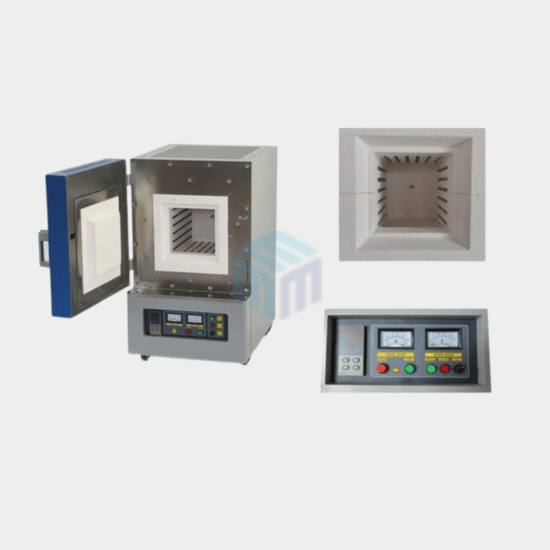
A muffle furnace is a type of high-temperature oven where the sample is isolated (or “muffled”) from the heating elements and combustion gases. This isolation helps prevent contamination and ensures uniform heat distribution.
In QA/QC labs, muffle furnaces are crucial because they allow:
- Accurate Ashing: Converting organic matter to ash to measure inorganic content.
- Loss-on-Ignition (LOI): Quantifying volatile components by heating and weighing the sample before and after.
- Material Characterization: Testing ceramics, metals, or polymers by subjecting them to controlled thermal cycles.
How Muffle Furnaces Enable Precise Ashing
Let’s break down the ashing process and see how a muffle furnace ensures accuracy:
-
Sample Preparation & Crucible Setup
-
-
- Use a clean porcelain or silica crucible. Preheat the crucible in the muffle furnace to burn off any residual contamination
- Weigh the empty crucible precisely (after cooling in a desiccator) to establish a baseline.
-
-
Controlled Heating
-
-
- Place the sample in the crucible and ramp up the temperature gradually to avoid spattering or loss.
- The target temperature for ashing usually lies between ~500–600 °C for many standard protocols.
- For advanced material analysis, high temperature muffle furnaces (e.g., 1200 °C, 1400 °C, 1600 °C, or even 1800 °C) are used depending on what needs to be ashed or sintered.
-
-
Holding Time
-
-
- Maintain the temperature until complete combustion of organics. For example, in food-material ash determination, some protocols use 550 °C overnight.
- For QC in polymer or filler analysis, faster modern systems (e.g., microwave muffle furnaces) can significantly cut ashing time while maintaining accuracy.
-
-
Cooling & Final Weighing
-
-
- Remove the crucible using tongs with heat-resistant gloves, and cool it in a desiccator to avoid moisture uptake. Muffle furnace ash is often hygroscopic—it can absorb moisture, skewing weight measurements.
- After cooling, weigh the crucible + ash. Use the difference in weight to calculate ash percentage.
-
-
Repeat to Confirm
-
- For accurate results, the heating–cooling–weighing cycle may be repeated until constant weight is achieved.
Why Use Different Temperature Ranges (1200 °C – 1800 °C)?
In QA/QC labs, not all ashing is the same — depending on the material, you may need different furnace-temperature capabilities:
| Temperature Range | Typical Applications |
|---|---|
| 1200 °C muffle furnace | For advanced organic–inorganic decomposition, or LOI in polymers and composites. |
| 1400 °C muffle furnace | For ceramics, advanced materials, or when ash contains high-melting-point residues. |
| 1600 °C muffle furnace | For refractory materials, advanced ceramics, and very high-temperature LOI/ash testing. |
| 1800 °C muffle furnace | Used in very specialized labs for ultra-high-temperature materials, sintering, or research-grade ashing. |
Using the right muffle furnace temperature ensures that:
- Organic material fully combusts without leaving black carbon.
- Inorganic ash remains stable and does not volatilize or decompose.
- Analysis results are reproducible and reliable.
Key Considerations in Lab Use
When using muffle furnaces in QA/QC labs, it’s important to be careful about:
-
Temperature Control & Accuracy
-
-
- Use furnaces with precise PID controllers. Inaccurate temperature control can lead to incomplete ashing or loss of volatile elements.
-
-
Airflow / Venting
-
-
- Good ventilation (or chimney/venting holes) helps remove combustion gases and ensures a stable atmosphere inside the furnace.
-
-
Cooling Management
-
-
- Use a desiccator to cool crucibles and avoid moisture-induced weight errors.
- Beware of thermal buoyancy: hot crucibles can experience convection currents which affect weighing if not cooled properly.
-
-
Sample Thickness / Loading
-
-
- Spread sample thinly to ensure even heating. Thick layers may char unevenly or trap unburnt carbon.
-
-
Choice of Crucible Material
-
-
- Porcelain or silica crucibles are common; for very high temp (e.g., 1600 °C+), specialized crucibles (e.g., high-purity alumina) may be needed.
-
-
Validation & SOPs
-
- Labs should have a validated SOP (Standard Operating Procedure) for muffle furnace use, including calibration, pre-heating crucibles, ramp rates, ashing times, and cooling protocols.
- Periodically check and calibrate both the furnace and the balance to maintain accuracy.
Real-World Benefits in QA/QC Labs
- Speed & Throughput: Modern microwave-muffle furnace systems reduce ashing time significantly (from hours to minutes) while maintaining accuracy.
- Cleaner Environment: Because the sample is isolated from heating elements, contamination risk is low and maintenance is easier.
- Versatility: With high-temperature capability (1200–1800 °C), labs can handle a wide variety of samples — polymers, ceramics, advanced materials, and more.
- Cost-Effectiveness: Though high-temp muffle furnaces can be expensive, accurate ashing reduces rework, improves lab reliability, and supports compliance with quality standards.
Common Pitfalls & How to Avoid Them
Here are some typical mistakes labs make — and how M-Kube’s high-quality muffle furnaces can help avoid them:
| Pitfall | Impact on Results | How to Mitigate |
|---|---|---|
| Incomplete combustion | Black or carbon-rich ash → inaccurate low ash % | Use correct temperature, ramp rates, and sufficient hold time. |
| Moisture uptake after cooling | Overestimation of ash % | Always cool in a desiccator; avoid exposure to humid air. |
| Volatilization of ash components | Loss of ash, underestimation of inorganic content | Use proper temperature — too high can vaporize salts. |
| Crucible contamination | Inconsistent baseline weights | Pre-calcine crucibles at set temperature until constant weight. |
| Unstable furnace control | Temperature fluctuations → poor reproducibility | Use furnaces with good PID control and regular calibration. |
Need a reliable, high-temperature muffle furnace for precision ashing and material analysis? Call +91 9898892994 or email marketing@mkubeenterprise.co.in to get pricing and specifications.
Conclusion
Muffle furnaces are foundational in QA/QC laboratories when it comes to ashing and material analysis. Their ability to precisely control high temperatures, isolate samples, and enable repeatable heating-cooling cycles ensures labs can derive reliable, reproducible data. Whether you’re working with polymers, ceramics, food matrices, or metals, choosing the right furnace temperature (1200 °C, 1400 °C, 1600 °C, or even 1800 °C) and following best practices makes all the difference.
At M-Kube Enterprise, we offer robust, high-performance muffle furnaces tailored for the rigorous demands of QA/QC environments. By helping labs optimize ashing processes, we support better quality control, faster testing cycles, and compliant operations.
References:
1. The use of microwave muffle furnace for dry ashing plant tissue samples
2. Faster Ashing Muffle Furnace Optimizes Determination of Fillers
3. How is the Ash Content Determined in a Muffle Furnace?