

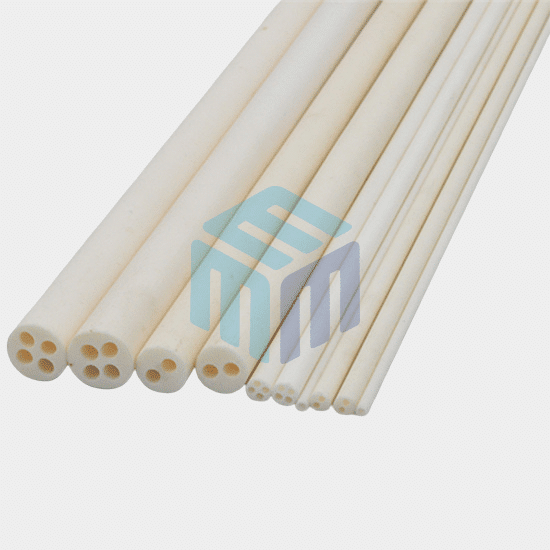
Alumina Tubes, made from high-purity aluminum oxide (Al₂O₃), are widely used in industries that demand high thermal resistance, excellent electrical insulation, and chemical stability. These tubes are popular in scientific, industrial, and manufacturing sectors due to their hardness, corrosion resistance, and capability to perform in extreme temperatures—up to 1800°C.
In recent years, demand has significantly grown for Alumina Tubes in India, with manufacturers and alumina ceramic tube suppliers serving sectors like metallurgy, energy, electronics, and healthcare. These tubes come in various forms, including Alumina Furnace Tubes, which are specifically designed for high-temperature furnace operations.
What Are Alumina Tubes & Alumina Rods
- Alumina (Al₂O₃) is a ceramic material known for its excellent thermal resistance (up to ~1800 °C or more), high hardness, chemical inertness, and electrical insulation.
- Alumina tubes are hollow cylinders used where lining, insulation or enclosure is required.
- Alumina rods are solid, used for supports, shafts, insulation pins, etc.
These materials are supplied in many forms by alumina ceramic tube and alumina rods suppliers in India, tailored to the shape, purity, tolerance, and size your application requires.
Key Applications of Alumina Tubes
They are widely used across industries due to their high-temperature stability, corrosion resistance, and excellent insulating properties. Their versatility makes them essential in both scientific and industrial environments. Here are some of the key applications of alumina tubes:
-
Thermocouple Protection Tubes
- Purpose: Alumina tubes are often used to protect thermocouples in high-temperature environments, where they serve as shields for the sensors against corrosive gases, molten metals, and other harsh conditions.
- Industries: Foundries, metal processing, and power generation facilities rely on alumina tubes to safeguard temperature sensors for accurate readings in extreme environments.
-
Furnace Tubes
- Purpose: They are utilized as heating elements or lining materials in industrial furnaces. Their high-temperature tolerance (up to 1800°C or more) and low thermal conductivity make them ideal for use in both electric and gas-fired furnaces.
- Industries: Widely used in industries like metallurgy, glass manufacturing, ceramics, and heat treatment processes.
-
High-Temperature Insulators
- Purpose: They are excellent electrical insulators and are used to protect electrical wiring and components in high-temperature applications.
- Industries: Electronics manufacturing, semiconductors industries benefit from alumina tubes’ insulating properties in high-heat environments where electrical isolation is necessary.
-
Kiln Furniture and Support Rods
- Purpose: In ceramic and glass production, alumina tubes are used as support rods, beams, or kiln furniture to hold materials during firing processes at high temperatures. Their durability ensures they can withstand repeated use without deformation.
- Industries: Ceramic manufacturing, including tiles, pottery, and advanced ceramics.
-
Chemical Processing
- Purpose: They are resistant to corrosion from many chemicals and are used in applications requiring high-purity containment and transport of reactive or corrosive chemicals at elevated temperatures.
- Industries: Chemical processing, petrochemical, and pharmaceutical industries use alumina tubes to handle aggressive chemical reactions and protect against contamination.
-
Catalyst Support Tubes
- Purpose: Alumina’s porosity and thermal properties make it an ideal material for catalyst support in chemical reactions, particularly in processes that require high-temperature catalytic reactions.
- Industries: Oil refining, petrochemical production, and environmental technology use alumina tubes in catalytic converters and reactors.
-
Diffusion and Vacuum Tubes
- Purpose: They are used in diffusion furnaces for semiconductor manufacturing and vacuum environments due to their high strength, purity, and resistance to oxidation.
- Industries: Semiconductor production, electronics, and advanced material research.
-
Sample Handling in Scientific Research
- Purpose: In laboratories, They are used to handle and contain materials during high-temperature experiments, sintering processes, or in environments where sample purity must be maintained.
- Industries: Research institutions, universities, and scientific labs.
-
Powder Processing and Gas Flow Tubes
- Purpose: They are used in powder processing applications and for directing gas flows in high-temperature processes. Their durability and resistance to wear make them ideal for prolonged exposure to abrasive particles or hot gases.
- Industries: Powder metallurgy, additive manufacturing, and material synthesis industries.
-
Medical and Dental Applications
- Purpose: They are used in specialized medical and dental equipment for their bio-inert properties and ability to withstand sterilization at high temperatures.
- Industries: Medical devices, dental implant production, and high-temperature sterilization equipment.
-
Wear-Resistant Linings
- Purpose: Due to their hardness and resistance to abrasion, alumina tubes are sometimes used as linings in areas exposed to heavy wear, such as slurry transport, pipelines, or milling equipment.
- Industries: Mining, chemical processing, and material handling.
-
Gas and Fluid Transport at High Temperatures
- Purpose: They are employed to transport gases and liquids in high-temperature and corrosive environments where other materials would fail or degrade.
- Industries: Power generation, oil and gas industries, and environmental technologies.
They are versatile and play an important role in applications where durability, high-temperature performance, and resistance to corrosion or contamination are critical. Their wide range of industrial and scientific uses makes them essential in processes that require reliability and precision
Also Read : Choosing the Right Alumina Tube for Your Application
Why Choose M-Kube for Alumina Tubes / Rods
- Extensive experience as alumina tube suppliers in India, serving industries with precisely engineered alumina tubes, alumina furnace tubes, and alumina rods.
- Wide range of grades, sizes, tolerances, and custom solutions to match your specific environment.
- High purity, excellent mechanical strength, outstanding thermal shock capability, and chemical stability.
- Reliable supply chain and support to help you select the right product (tube vs rod, dimensions, tolerances, etc.).
Conclusion
With exceptional properties such as high-temperature resistance, corrosion protection, and electrical insulation, Alumina Tubes are essential across modern industries. From high-temperature furnaces and chemical laboratories to semiconductor manufacturing, Alumina Tube Suppliers—particularly those offering Alumina Tubes in India—are vital in supporting advanced technologies and manufacturing needs.
If you are looking for reliable alumina tube suppliers in India, high-quality alumina rods, or alumina furnace tubes that meet strict industrial or laboratory standards, contact M-Kube Enterprise today.
- Call us at +91 98988 92994
- Email: marketing@mkubeenterprise.co.in
- Request a quote: [Inquiry Now Form in our website]
We can help you select the right alumina tubes, alumina rods, or alumina ceramic tubes tailored to your temperature, chemical, and mechanical requirements — ensuring performance, durability, and cost-effectiveness.
M-Kube Enterprise is an Indian company catering customized laboratory products, laboratory consumables, and laboratory solutions in India, Australia, the USA, New Zealand, Singapore, Malaysia, South Korea, Dubai, the Philippines, Indonesia, and Vietnam.