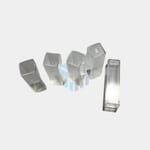



Spectrophotometers are widely used in pharmaceutical laboratories, chemical testing, food analysis, environmental testing, biotechnology, and academic research. These instruments provide accurate measurements of how much light a sample absorbs or transmits at specific wavelengths.
However, the accuracy of a spectrophotometer does not depend only on the instrument itself. The Spectrophotometer Cells or cuvettes used to hold the sample also play an important role. Choosing between quartz and glass cuvettes can directly affect wavelength range, measurement accuracy, repeatability, and overall testing performance.
For laboratories selecting quartz cuvettes for spectrophotometer applications, understanding the differences between quartz and glass is essential.
What Is a Spectrophotometer Cuvette?
A cuvette is a small transparent container designed to hold liquid samples during spectrophotometric analysis.
The light beam passes through the cuvette and the sample inside it. The spectrophotometer then measures the amount of light absorbed or transmitted.
Cuvettes are available in different materials and designs, including:
- Quartz cuvettes
- Glass cuvettes
- Plastic cuvettes
- Standard spectrophotometer cells
- Micro-volume cells
- Fluorescence cells
- Round-bottom cells
- Special-purpose cells
The correct cuvette depends on the instrument, wavelength range, sample volume, and application.
What Are Quartz Cuvettes?
Quartz cuvettes are manufactured from high-purity quartz or fused silica. They are designed for applications where excellent optical transmission and chemical stability are required.
A Spectrophotometer Quartz Cuvette is particularly valuable when measurements extend into the UV region.
Advantages of Quartz Cuvettes
Quartz offers several important benefits:
- Excellent UV transmission
- Excellent visible-light transmission
- High chemical resistance
- Superior thermal stability
- Low fluorescence in suitable applications
- Excellent dimensional stability
These characteristics make quartz cuvettes for spectrophotometer applications particularly suitable for analytical laboratories performing UV-Vis measurements.
What Are Glass Cuvettes?
Glass cuvettes are commonly used for visible-range spectrophotometric measurements.
They are generally less expensive than quartz and can be suitable for routine applications where measurements do not extend into the UV range.
Advantages of Glass Cuvettes
- Lower purchase cost
- Suitable for many visible-light measurements
- Good optical clarity
- Suitable for routine laboratory testing
For laboratories performing predominantly visible-range measurements, glass can be a practical and economical choice.
Why Quartz Is Better for UV Measurements
One of the most important reasons to select quartz is its ability to transmit ultraviolet wavelengths effectively.
Many analytical applications require measurements below the transmission range of conventional optical glass.
Examples include:
- Nucleic acid analysis
- Protein analysis
- UV absorption studies
- Pharmaceutical testing
- Chemical analysis
- Research applications
In these cases, using a glass cuvette can produce inaccurate or unreliable measurements because the cuvette itself absorbs part of the UV radiation.
A Spectrophotometer Quartz Cuvette minimizes this limitation and allows the instrument to measure the sample more effectively.
When Glass Cuvettes Are a Better Choice
Quartz is not automatically the best option for every application.
Glass cuvettes can be a better choice when:
- Testing is limited to the visible range
- Large numbers of routine measurements are required
- Cost control is important
- UV transmission is not required
- The sample is compatible with glass
For basic colorimetric and visible-light testing, glass standard spectrophotometer cells may provide excellent performance at a lower cost.
Standard Spectrophotometer Cells
standard spectrophotometer cells are commonly used for routine UV-Vis laboratory testing.
They are available in different optical path lengths and capacities to accommodate different sample requirements.
Standard cells are frequently used for:
- Chemical analysis
- Pharmaceutical testing
- Food testing
- Water analysis
- Educational laboratory work
When selecting Standard Cells, laboratories should ensure that the cell material is compatible with the required wavelength range.
Spectrophotometer Precision Cells
For applications requiring higher measurement consistency, spectrophotometer precision cells can provide tighter dimensional tolerances and improved optical performance.
Precision cells are useful when:
- High repeatability is required
- Multiple measurements must be compared
- Small absorbance differences are important
- Research-grade analysis is being performed
The quality and consistency of the optical faces are particularly important in precision measurements.
Standard Cell with PTFE Lid
A Standard Cell with PTFE Lid can be useful when sample protection and secure handling are important.
The PTFE lid can help:
- Reduce sample evaporation
- Minimize contamination
- Protect the sample from the surrounding environment
- Improve handling during measurement
This type of cell can be particularly useful for volatile or sensitive samples.
Standard UV Quartz Cell With Lid
A Standard UV Quartz Cell With Lid combines the UV transmission advantages of quartz with a protective lid.
It is suitable for applications requiring:
- UV-Vis measurements
- Reduced evaporation
- Sample protection
- Consistent measurement conditions
For pharmaceutical, chemical, and research laboratories, this design can provide additional convenience during routine analysis.
Round-bottom Standard Cell
A Round-bottom Standard Cell is another specialized cuvette design used for particular laboratory applications.
The geometry can be selected based on:
- Instrument configuration
- Sample volume
- Optical requirements
- Sample handling considerations
Before purchasing a specialized cell, laboratories should verify compatibility with their spectrophotometer.
How to Choose the Right Cuvette
Laboratory professionals should consider several factors before selecting a cuvette.
- Wavelength Range
- Sample Volume
- Optical Path Length
- Chemical Compatibility
5. Temperature Requirements.
Common Applications of Quartz Cuvettes
quartz cuvettes for spectrophotometer are widely used in:
Pharmaceutical Laboratories
Applications include:
- Drug analysis
- UV absorbance measurements
- Raw material testing
- Quality control
Biotechnology and Life Sciences
Quartz cells are commonly used for:
- DNA analysis
- RNA analysis
- Protein measurements
- Enzyme studies
Chemical Laboratories
Applications include:
- UV-Vis spectroscopy
- Reaction monitoring
- Compound characterization
- Concentration measurements
Environmental Testing
Quartz cuvettes can be used for:
- Water analysis
- Pollutant testing
- Chemical monitoring
Why Cuvette Quality Matters
Even a high-quality spectrophotometer cannot compensate for a poor-quality cuvette.
Problems such as:
- Scratches
- Fingerprints
- Contamination
- Optical defects
- Incorrect orientation
- Inconsistent dimensions
can affect measurement results.
Therefore, laboratories should handle cuvettes carefully and clean them according to the manufacturer’s recommendations.
Conclusion
Choosing between quartz and glass cuvettes depends on the wavelength range, sample characteristics, accuracy requirements, and laboratory budget. While glass can be an excellent choice for routine visible-light measurements, quartz provides significantly greater versatility for UV-Vis analysis.
For laboratories performing UV measurements, Spectrophotometer Quartz Cuvette products offer excellent optical transmission, chemical resistance, and thermal stability. Options such as standard spectrophotometer cells, spectrophotometer precision cells, Standard Cell with PTFE Lid, Standard UV Quartz Cell With Lid, and Round-bottom Standard Cell allow laboratories to select the appropriate design for their specific testing requirements.
Ultimately, selecting the right cuvette is just as important as selecting the right spectrophotometer. A properly matched, high-quality cuvette helps laboratories achieve accurate, repeatable, and reliable analytical results.
Looking for high-quality Spectrophotometer Quartz Cuvette, quartz cuvettes for spectrophotometer, or precision Spectrophotometer Cells for your laboratory?
We offer a range of standard and specialized cuvettes designed for pharmaceutical, chemical, food, environmental, biotechnology, and research applications across India.
📞 Call: +91 9898892994 OR 📧 Email: marketing@mkubeenterprise.co.in today for expert guidance on selecting the right Standard Cells, spectrophotometer precision cells, Standard Cell with PTFE Lid, or Standard UV Quartz Cell With Lid for your spectrophotometer.