

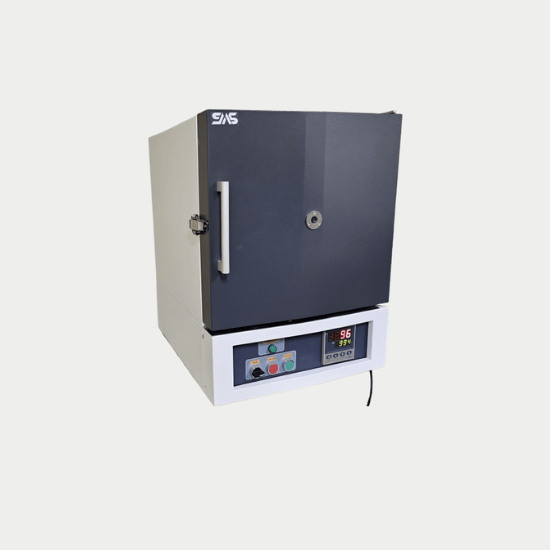
When a muffle furnace displays 1000°C (1832°F), it is easy to assume that the sample inside the chamber is also experiencing exactly 1000°C.
In practice, furnace temperature is a little more complicated.
The temperature shown on the controller is based on the furnace’s temperature-sensing and control system. The actual temperature experienced by a sample can vary depending on thermocouple location, heating-element arrangement, insulation, chamber loading, door openings, and temperature gradients.
This difference becomes particularly important when laboratory results depend on repeatable heating conditions.
Whether you are using a furnace for ashing, calcination, heat treatment, ceramics, materials testing, or research, understanding muffle furnace temprature performance can help you select and operate equipment more effectively.
What Does 1000°C Really Mean?
A furnace temperature specification can refer to several different values:
Setpoint temperature – the temperature selected by the operator.
Displayed temperature – the value shown by the controller.
Measured temperature – the temperature detected by the furnace sensor.
Sample temperature – the temperature actually experienced by the material being processed.
These values may be very close, but they should not automatically be considered identical.
Temperature is measured at a particular location, while the sample may occupy another position inside the chamber. As a result, the sample environment can differ from the controller’s measurement point.
This is why furnace specifications often provide information about temperature stability and uniformity in addition to maximum operating temperature.
Temperature Accuracy vs. Temperature Uniformity
| Parameter | What It Means | Why It Matters |
| Temperature Accuracy | How closely the measured temperature represents the actual temperature | Important for reliable process control |
| Temperature Stability | How consistently the furnace maintains temperature over time | Important for repeatable heating cycles |
| Temperature Uniformity | How much temperature varies between different locations in the chamber | Important when samples need similar thermal exposure |
A furnace may maintain a stable reading at its sensor while different parts of the working chamber experience somewhat different temperatures.
Thermcraft notes that temperature uniformity is particularly important in research and development because temperature differences can affect reaction rates, material properties, and microstructure formation.
Why Can Muffle Furnace Temperature Vary?
1. Thermocouple Location
A thermocouple measures temperature at its own location. If the sample is positioned somewhere else in the chamber, the two locations may not experience exactly the same temperature.
Thermocouple type, placement, and condition can therefore affect the measurement.
2. Heating-Element Arrangement
Heating elements play a major role in distributing heat throughout the chamber.
Some furnace designs use heating elements on multiple sides, while others use different heating zones to improve uniformity. Thermcraft, for example, offers single- and multi-zone furnace configurations, with independent control of zones available to improve the uniform heated area.
3. Chamber Loading
A furnace operating empty does not necessarily behave exactly like the same furnace under a heavy sample load.
Crucibles, trays, ceramic fixtures, and large samples can affect heating and temperature recovery.
4. Door Opening
Opening a hot furnace introduces cooler surrounding air and allows heat to escape.
Repeated door opening can therefore cause temperature fluctuations and increase the time required for the furnace to return to its setpoint.
5. Insulation and Heat Loss
Insulation helps minimize heat loss and maintain a stable chamber environment.
At higher temperatures, furnace construction becomes increasingly important because the equipment must continuously manage substantial thermal energy while maintaining the desired process temperature.
Understanding Different Muffle Furnace Temperature Ratings
Maximum temperature is one of the first specifications buyers consider, but it should not be the only consideration.
1200 C Muffle Furnace
A 1200 C Muffle furnace is commonly used for general laboratory applications such as ashing, calcination, heat treatment, and materials testing. Thermcraft’s 1200°C box furnace, for example, specifies a 1200°C maximum operating temperature and publishes temperature-uniformity profiles for the heated chamber.
1400 C Muffle Furnace
A 1400 C Muffle furnace provides a higher operating range for applications requiring more demanding thermal processing. At this temperature level, the heating elements, insulation, thermocouple, controller, and chamber construction become important considerations. Thermcraft identifies 1400°C and 1600°C box furnaces as a separate temperature class using silicon carbide heating elements.
1600 C Muffle Furnace
A 1600 C Muffle furnace is suitable for higher-temperature applications such as advanced materials research, ceramics, refractory testing, and specialized heat treatment. Thermcraft lists 1600°C laboratory furnace configurations among its high-temperature furnace products.
1800 C Muffle Furnace
An 1800 C Muffle furnace is intended for very-high-temperature applications. At this temperature, heating-element technology becomes especially important. Thermcraft’s 1700°C/1800°C box-furnace range uses molybdenum disilicide (MoSi₂) heating elements and is designed for rapid heating and temperature uniformity.
The important point is that a higher maximum temperature does not automatically mean better performance for every application. The furnace should be selected according to the actual process requirements.
Why Temperature Calibration Matters
Even a well-designed furnace needs appropriate temperature verification when accurate and repeatable results are important.
Calibration involves comparing the furnace’s measurement against a suitable reference under controlled conditions.
Temperature verification can help identify:
- Sensor measurement errors
- Temperature offsets
- Changes in furnace performance
- Temperature drift
- Differences between the controller reading and an independent measurement
For critical laboratory processes, periodic verification can provide additional confidence that the furnace is operating within the required specifications.
How Can You Check Muffle Furnace Temperature Accuracy?
- Set the furnace to the required operating temperature.
- Allow sufficient time for the chamber to stabilize.
- Use an appropriate calibrated reference temperature sensor.
- Position the reference sensor according to the verification procedure.
- Compare the independent measurement with the controller reading.
- Record the difference.
- Repeat at other important operating temperatures when required.
If the application requires temperature uniformity, measuring multiple points inside the usable chamber can provide more useful information than checking only the controller’s sensor location.
Thermcraft publishes temperature profiles for some laboratory furnaces to demonstrate variation across the heated area. For example, one 1200°C furnace configuration specifies ±5°C uniformity over an 8-inch section and ±1°C over a 3-inch section under its stated test conditions.
What Should You Consider When Buying a Muffle Furnace?
| Factor | What to Check |
| Maximum Temperature | Required peak temperature |
| Working Temperature | Temperature used most frequently |
| Uniformity | Temperature variation across the working area |
| Stability | Temperature variation over time |
| Chamber Size | Space required for samples and fixtures |
| Controller | PID control, programming, and monitoring |
| Thermocouple | Type and operating range |
| Heating Elements | Material and expected operating conditions |
| Calibration | Verification and documentation requirements |
| Service | Maintenance, spare parts, and technical support |
A laboratory that needs to operate routinely at 1000°C may not necessarily need the highest-temperature furnace available.
Similarly, a laboratory requiring 1600°C or 1800°C operation should consider whether the furnace’s complete construction and control system are appropriate for continuous operation at those temperatures.
What About Muffle Furnace Price?
Muffle furnace price can vary significantly depending on maximum temperature, chamber size, heating-element technology, insulation, controller features, safety systems, calibration options, and additional accessories.
For this reason, comparing furnaces based only on purchase price can be misleading.
A better approach is to compare the complete specification against the actual application:
Required temperature + chamber size + uniformity + control + calibration + service support
This helps ensure that the selected furnace provides the required performance without paying for specifications that are unnecessary for the process.
Common Mistakes to Avoid
- Choosing a furnace only by its maximum temperature.
- Assuming the displayed temperature equals the sample temperature.
- Ignoring temperature uniformity.
- Overloading the chamber.
- Frequently opening the furnace during processing.
- Not verifying temperature when accuracy is critical.
- Ignoring thermocouple condition and placement.
- Comparing muffle furnace price without comparing technical specifications.
Conclusion
A furnace display showing 1000°C is only one part of the temperature-control picture.
The actual thermal environment depends on the temperature sensor, controller, heating elements, insulation, chamber design, sample loading, and temperature distribution.
Whether you are selecting a 1200 C Muffle furnace, 1400 C Muffle furnace, 1600 C Muffle furnace, or 1800 C Muffle furnace, the right choice should be based on the actual process requirements rather than maximum temperature alone.
Understanding temperature accuracy, stability, and uniformity can help laboratories achieve more consistent heating conditions and more reliable results.
For laboratories and industrial users, selecting the right high temperature muffle furnace is ultimately about matching the furnace’s capabilities to the process.
Looking for a Muffle Furnace?
M-Kube India supplies laboratory and scientific equipment for research, testing, and industrial applications.
If you are looking for a muffle furnace, need help comparing furnace specifications, or want assistance selecting the appropriate temperature range for your application, contact our team.
Phone: +91 9898892994
Email: marketing@mkubeenterprise.co.in